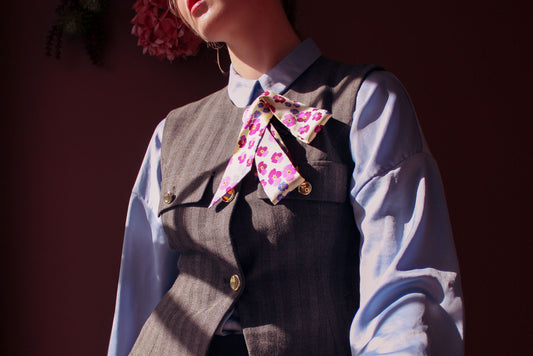
On Where Things Are Made
There is a difference between where something is finished,
and where it truly comes from.
Not just in geography —
but in the choices behind it.
Each of our scarves carries more than a place of origin.
It carries a series of decisions.
Designed in Stavanger, Norway

Every piece begins slowly.
In Stavanger, the process is not driven by seasons or volume, but by development — of colour, composition, and balance.
Ideas are allowed time.
A design is not released because it is needed.
Only because it is ready.
There is a certain restraint in that.
Made in Macclesfield, England

From design, the process moves to Macclesfield — a place long associated with silk.
Here, production is not scaled for speed, but for precision.
The printing, the finishing, the handling of the fabric — each step is carried out with an attention that comes from experience, not automation.
This is not the fastest way to produce.
It is, however, one that allows the material to remain what it is.
Finished in Fredrikstad, Norway

The final stage brings us to Fredrikstad, where each piece is given a home in jewelry quality packaging.
The box, the card, the way it is presented — none of it is incidental.
In Stavanger we carefully select your piece and place it into its Norwegian made, plastic free box. This is the last point of contact before it reaches you.
And it is treated accordingly.
Why We Choose This Way
It would be simpler to produce everything in one place.
Faster. Less costly. More efficient.
But simplicity is not always the same as integrity.
By working across these locations, we choose:
- environments where skill is preserved
- production where quality is not compromised
- partners who are paid fairly, and work within protected conditions
This comes at a higher cost.
But it ensures something else —
that what is made carries consistency, not compromise.
A Different Kind of Transparency
“Made in” is often reduced to a label.
A single line, placed at the edge.
But origin is rarely singular.
It is layered —
design, production, finishing.
We believe each part should be visible.
Not loudly.
But clearly.
A Final Note

Where something is made is not only about place.
It is about how.
How it is developed,
how it is handled,
how the people involved are treated along the way.
These are not always visible.
But they remain —
in the object itself,
and in the way it endures.