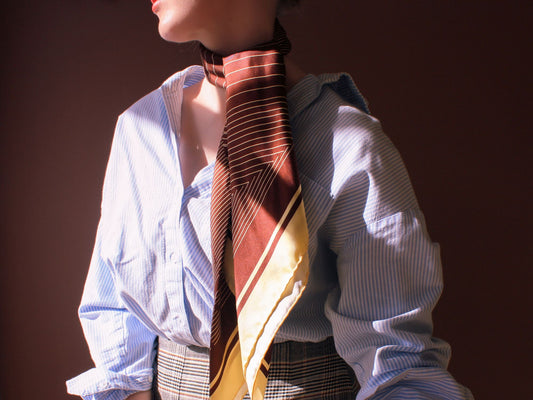
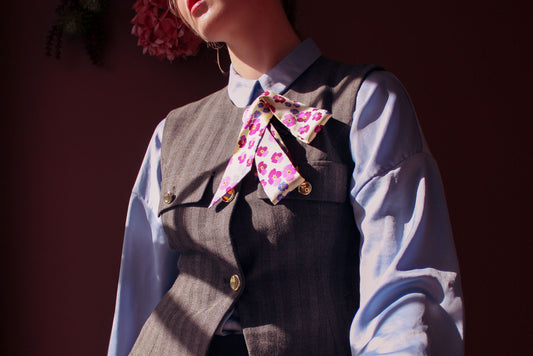
Borrowed from Tailoring: Three Tie Knots Reimagined in Silk
For generations, the tie knot has been a subtle emblem of structure, discipline, and masculine dress codes. Its language is precise: over, under, through. Measured. Intentional.
In silk, these same knots soften. They breathe. When translated into a 90 × 90 cm silk square, classic tie techniques are transformed into something expressive and fluid — bringing the rigor of tailoring into the poetry of women’s fashion.
Here are three silk scarf knots inspired directly by traditional men’s tie culture, reinterpreted through movement, texture, and light.
1. The Classic Tie Knot (Silk Edition)

Structured, timeless, effortlessly polished
This knot mirrors the familiar rhythm of a classic necktie knot — balanced and symmetrical — but rendered in silk for softness and versatility.
How to tie it:
-
Fold the scarf on the diagonal, then continue folding into a long, even band.
-
Place it around the neck with one end slightly longer than the other.
-
Cross the longer end over the shorter end at the center of the chest.
-
Bring it under and back over the front once more.
-
Guide the longer end up through the loop at the neck.
-
Pull it down through the front loop, adjusting gently to shape the knot.
Slide the knot upward and center it. The silk should sit neatly, never tight.
Why it works:
-
Echoes classic tailoring with a softer expression
-
Ideal for blouses, blazers, and clean necklines
-
Highlights the scarf’s texture without excess volume
2. The Cape Tie Knot

Tailored at the center, fluid at the edges
The Cape Tie Knot frames a classic tie knot with two elegant bands of silk, creating a silhouette that feels both structured and expansive — like a tailored piece worn open.
How to tie it:
-
Fold the scarf diagonally, then into a long band, leaving it slightly wider than usual.
-
Drape it around the neck so both ends fall evenly.
-
Tie a classic tie knot at the center, following the steps above, but do not pull it tight.
-
Gently separate and smooth the outer edges of the scarf so they fan outward on either side of the knot.
The result is a central knot framed by cascading silk — composed, yet relaxed.
Why it works:
-
Uses the full width of the 90 cm scarf
-
Creates a cape-like effect without bulk
-
Ideal for coats, dresses, and evening styling
3. The Trinity Tie Knot

Architectural, modern, and quietly bold
Inspired by the Trinity tie knot, this version forms a triangular, sculptural shape at the neck — a statement knot that rewards patience and precision.
How to tie it:
-
Fold the scarf into a long, narrow band.
-
Drape it around the neck with one end significantly longer than the other.
-
Using the longer end, cross it over the shorter end, then bring it up through the neck loop.
-
Wrap the long end across the front, then around the back of the shorter end.
-
Bring it up through the neck loop again, and thread it down through the triangular opening forming at the front.
-
Adjust slowly, shaping the knot into a clean triangular form.
The knot should sit slightly off-center, with deliberate asymmetry.
Why it works:
-
Creates a striking, geometric focal point
-
Best suited for solid or subtly patterned silks
-
Elevates minimalist outfits instantly
Silk Meets Structure
By borrowing from the language of men’s tailoring, these knots bring intention and craftsmanship into silk styling. They honor precision while embracing fluidity — proving that elegance is often found where discipline and softness meet.
A silk scarf tied this way does not decorate.
It defines.